Monthly Archives: February 2014

Some Observations about Lighting Modifiers

This week we are going to discuss a few things about lighting modifiers. With very few exceptions, lighting modifiers do just 2 basic things. They change the size and the shape of a light source. That’s really all they do. The differences between modifiers is how they achieve those two properties.

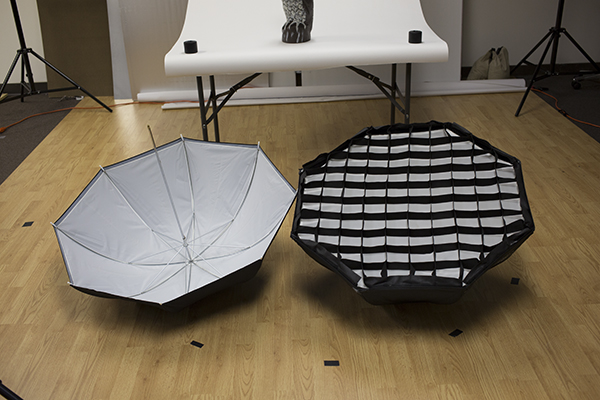
This week we are going to compare two modifiers of very similar size. One is a 35 inch Octobox with a grid and the other is 36 white umbrella.

35 inch Octobox vs. 36 inch Umbrella

35 inch Octobox vs. 36 inch Umbrella

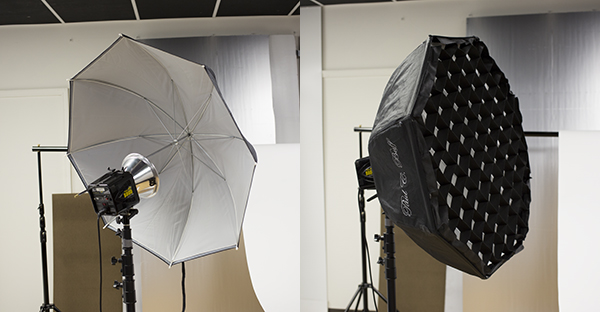
The mechanical difference between these two modifiers is that the umbrella bounces the light from the flash head to the subject to obtain diffusion, where as the octobox mounts directly on the light and uses a diffusion panel to dissipate the light. The grid on the panel helps prevent spill (keeps more light in the general direction of the subject). Below is a photo of them mounted on a light.

Umbrella and Octobox

Umbrella and Octobox

From what we know about basic light theory, the effective size of a light source determines the harshness or softness of the light. A larger light source produces a softer shadows and a small light source produces harsher shadows. Following that, these two modifiers should produce the shadow characteristics. Let’s take a look as see how that pans out.

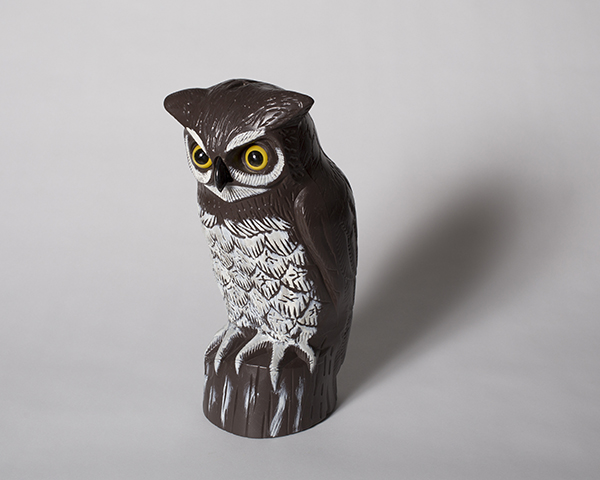
This first photo was shot with the umbrella.

umbrella1

Umbrella


One obvious thing we notice about about this photo is the shadow. Most of it is uniform with feathering occurring  at the outside edges.

Octobox

Octobox

Now look at the photo above that was shot using the octobox. The shadow looks quite different. It is much denser at the center with a larger area that is feathered. Why would these two lighting modifiers of equal size produce such different shadow characteristics?

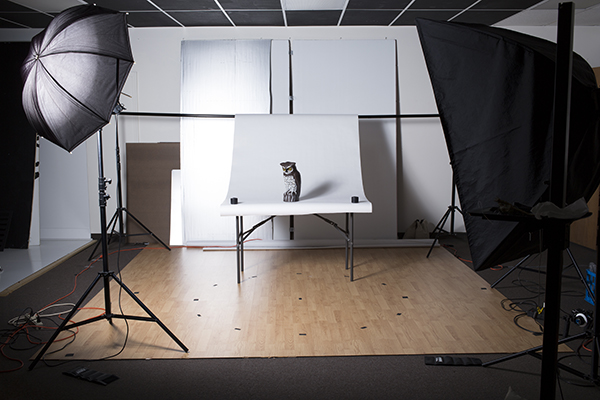
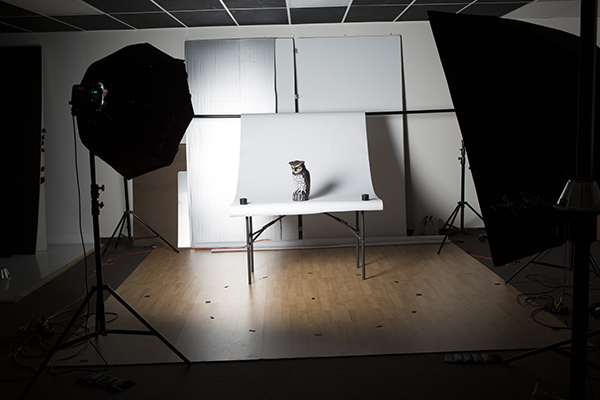
The explanation can be seen when we step back and look at the overall set. The photo below is a photo of the set from across the room showing the light pattern produced by the umbrella.

Umbrella

Umbrella

Because the umbrella creates lots of spill, light is blasted all over the studio. We can see that light actually escapes through the back of the umbrella.

Octobox

Octobox

The octobox has a much more defined light throw. The grid helps confine the light even more and makes it even more directional. (Notice that no light escapes from the back of the modifier).

Ok, so how does this explain the difference in the quality of the shadows? One word: bounce. Because the umbrella sprayed light all over the studio much of bounced back to the subject and softened the shadow. If this was shot in a large open field or in a large studio the effects of bounce would not be seen and the shadow characteristics would be nearly the same.

A side lesson to be learned from this experiment is that, if you are used to the performance of a certain modifier in your studio, when shooting on location you may experience different results. Remember that your environment can affect the quality of your light.

An FYI: if you look at the photos of studio, you’ll notice that ceiling panels are painted flat black. This was done to help reduce bounce and to keep control of the quality of shadows.

That’s it for this week. Thanks for reading.

-Ken

Six Years of Blogging

I started this blog in 2008 with the intent of updating it every week. Well, that didn’t happen. Coming up with something new and interesting over six years is pretty difficult. At best count, this is my 245th posting to this blog. That may not seem like a large number but for me it has been a struggle. A happy struggle.

That said, I’m ready to try for another 245 posts, if you are willing to stick it out with me. I have some ideas for new posts that may be a little more educational in nature. Plus, I’ve update the blog software on my server, so hopefully that will help. I’m on a search for software so I update my website. So far, I installed Joomla and played with it a little. I think it is overly complex for what I an wanting to do. But hand coding using HTML and Javascript is too cumbersome. In the next couple of weeks I hope to have a solution and will be working on the site.

Once a again, thanks for reading!!

-Ken

The difference between studio strobes and speedlites.

This week we are going to talk about some very basic differences between studio strobes versus speedlites. First of all, lets start off by discussing what a studio strobe is and what a speedlite is. Studio strobes typically run on AC power or have a battery pack that runs on or is recharged using AC power. They are designed to be mounted on light stands and will accept a variety of modifiers. Battery powered, small flash units that are designed to be mounted on a camera, I going to refer to as speedlites. Actually, Canon calls their flash units Speedlites and Nikon calls theirs Speedlights. Other companies have their own names for their models, but essentially they work the same. Many speedlites will also run on AC power, but they are really designed for DC battery power.

Let’s look at the way a studio strobe looks and works. Below is a common studio strobe.

Studio Strobe

Studio strobes come in a variety of shapes and sizes and each brand has their own design, but for the most part they work the same way. Some are just a flash head (flash tube and modeling light) and the power supply and controls reside on another unit connected by a cord. The strobe pictured above is called a monolight, because everything is contained in one unit. Studio strobes typically have two lights on them. One is a modeling light and the other is the actual flash tube. The modeling light attempts to give you a representative view of what the light is going to look like when flash tube discharges. The flash tube itself creates the real light. The power output of a studio strobe is variable and the the degree of variability is dependent on the brand and model of the light. Studio strobes have brackets that allow them to be mounted on standard light stands.

The photo below is of a speedlite.

Speedlite.

The speedlite is considerable smaller than a studio strobe. You will notice that there is no large reflector and there is no modeling light on a speedlite. It’s flash tube is a small and, instead of circular, it’s straight. Although they can be mounted to light stands using an adapter, speedlites are designed to be mounted to your camera’s hot shoe. Speedlites usually have two types of power settings. There is a manual setting that allows you to control the flash’s output and there is usually an automatic feature. On the automatic setting (and if you are using a compatible camera) the flash and the camera communicate with each other. Based on the camera’s settings, the flash knows how much light it needs to produce to get the proper exposure.

OK, so now you may be wondering how they are differ in use. Studio strobes can be used on location with portable battery packs or using a small generator, as well as used in the studio. Because they are considerably more powerful than speedlites, they can create cool effects when used outdoors. Since they are made to be used with modifiers (umbrellas, grids, soft boxes, PLMs, etc.) you can easily change the quality and shape of the light. The downside is that they are more cumbersome and are not easily portable. If used outdoors (and especially with large modifiers), they often need to be sandbagged in windy conditions or they will be blown over.

Speedlites, on the other hand, are lightweight, small, and easy to handle. Because they are not as powerful they don’t have the reach of studio strobes. They cycle faster so you can be ready shoot another photo more quickly. Because of their size and power output they don’t work as well with modifiers. But for event photography (weddings, parties, conferences, etc) they excel beyond what you can do with studio strobes. They work well for most any dynamic environment where light stands and studio strobes are just not practical.

WARNING TECHNO-GEEK SPEAK: There is also a difference between studio strobes and speedlites that usually doesn’t get mentioned. It’s kinda technical, so bear with me. At their most elemental, all flash units work the same way. They take power from a source (AC power or a battery) store/accumuate it in an electronic component called a capacitor. When you hit the shutter, the electricity flows from the capacitor to the flash tube and you get that bright light flash and that pop noise. But there a difference between how studio strobes and speedlites achieve their variable output. Understanding this can allow you to do some neat things.

Studio strobes achieve their variable power setting changing the amount of electricity stored in the capacitor. For instance, the flash unit at half power stores half the electricity than it stores at full power. So, what can happen is this: if your turn on your studio strobe and set the power to full, the capacitor stores the maximum amount of electricity. Now, lets say you turn the power to half power before you discharge the light. The capacitor still has the full charge so if you take a photo and your camera is set to properly expose a photo at half power, you will get an over-exposed image. Some studio strobe makers have found a way to drain power from capacitor when you reduce power. Otherwise, its a good idea discharge your studio strobe whenever you reduce the power.

Speedlites work differently. They are designed to conserve battery power and to be able to cycle quicker. The way they work is to fully charge the capacitor all the time. So how do they have variable output? They change the duration of the flash itself. So, at full power, the flash duration may be 1/4000 of a second. When you set it to half power, the flash duration changes to 1/8000 of second. This means that lower power settings, the speedlite can recycle and be ready to shoot again very quickly. (These flash durations are for example only and will change or be different depending on the brand and model of your speedlite).

There’s also and other “side effect” to this behavior. It means that in a dark environment, you can create some neat effects. With such a short duration you have the effect of using an extremely high shutter speed, even if you never exceed your maximum sync speed. For instance, the photo below is of a soap bubble popping on the tip of a wood screw.

High speed flash.

If you feel like experimenting, you can create some fascinating photos playing with this technique.

Well, I got long winded this week. If you finished reading this, thanks for sticking with it and I hoped you learned something.

-Ken

Canon 600mm F/4 IS. An informal test.

OK, last week a friend of mine, Joe, brought in his Canon 600mm lens for some informal tests. Joe is a wildlife photographer and testing the lens in the field is difficult because of changing light conditions, moving subject matter, and other factors that effect consistency. I jumped at the change to spend a couple of hours playing with the lens in the studio.

First of all the lens is heavy. I mean REALLY heavy. Shooting it handheld isn’t really a good option. It is really well made and very robust. If you were in the woods and a bear attacked you, you could use it successfully to defend yourself. The price tag on a new 600mm is nearly $13,000, so it’s pretty pricey.

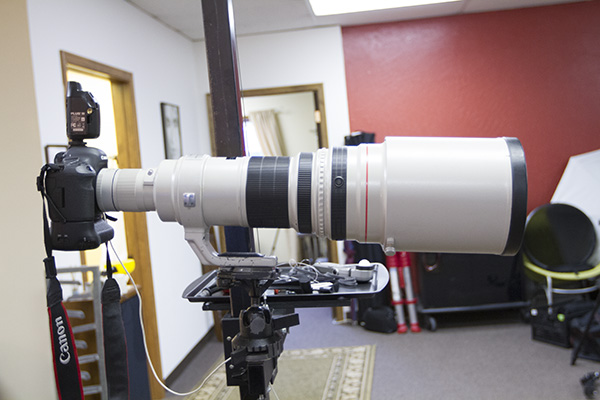
Here is what it looks like attached to my Canon 5D Mk III and battery grip. (More accurately it feels more like the camera attaches to the lens. ) 😉

Canon 600mm f/4 IS lens

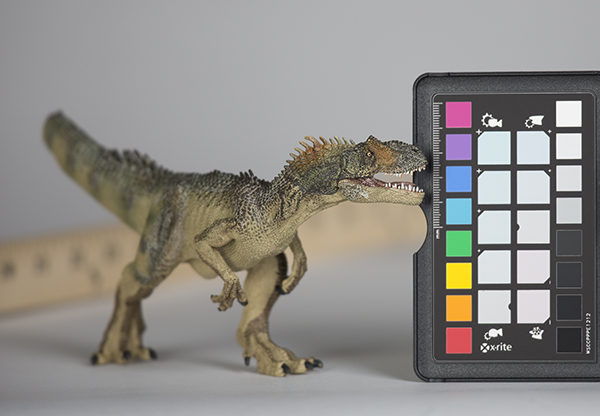
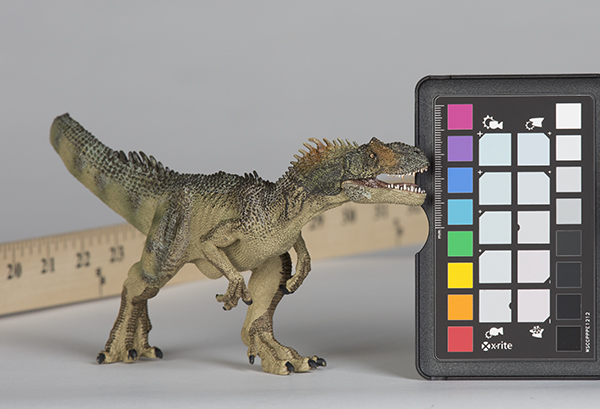
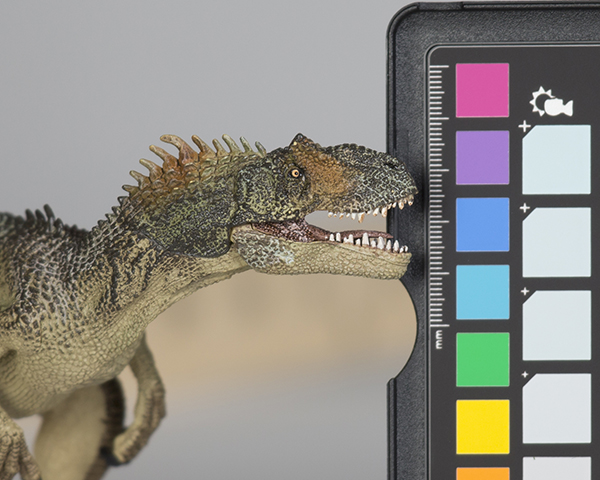
One of the goals of our informal test was to see how sharp the lens was wide open in opposed to shooting it at a smaller aperture. The tests were far from scientific, but I think they indicate how ridiculously sharp this lens is under all conditions. This first shot is taken with the lens at f/4 at 160th of second at ISO 160.

600mm f/4

This next shot is at f/14. There is no noticeable difference in sharpness at the focus point (the dinosaur’s eye). The depth of field is really different, as you would expect, but the sharpness is the same as f/4.

600mm f/14

Here is close up of the photo shot at f/4.

600mm f/4

Here is a close of the photo shot at f/14. DOF is the only real difference.

600mm f/14

It’s amazing that a lens that big can be so sharp. When you pay that much for a lens, there’s a reason for it.

We did one more test to see how well the lens performed with a 1.4x teleconverter. The teleconverter caused the lens to lose a stop on the wide end and became a 840mm f/5.6 lens. Shooting it wide open caused a very slight degradation in image quality and sharpness, but still very respectable and very useable. However, the degradation disappeared as we stopped the lens down.

My overall impression of lens is overwhelmingly positive. It’s big, heavy, and expensive, but I don’t see how another lens could perform any better. This lens is scalpel sharp and it focuses so fast it’s scary. If I was a sports shooter or wildlife photographer, this lens would definitely be on the top of my wish list. Two thumbs up.

Thanks for reading!

-Ken

Loading...
X